CUSTOMER ALERT Beware of fraudulent websites using our name. We do not sell on Craigslist or Facebook Marketplace. Report suspicious contacts to 713-670-8801.

A 40ft container is a standardized steel box built for long-distance cargo movement. It is twice the length of a 20ft container and commonly measures about 12.19 meters long, 2.44 meters wide, and 2.59 meters high externally. Its internal space is usually close to 67 cubic meters, although manufacturers and models differ slightly. That small difference matters.
Lars Jensen, an independent container-shipping analyst, has described containers as “the basic building blocks of global trade.” His observation explains their practical value. A 40ft container can carry furniture, packaged machinery, textiles, or carefully secured retail goods between ships, railways, and trucks. Forklift pockets, corner castings, locking bars, and weather-resistant steel support this transfer. However, cargo volume is not the only limit. Payload restrictions, axle weights, loading patterns, and local transport rules can reduce usable capacity. The heaviest cargo may fill only part of the available space.
A 40ft container is not simply a larger storage room. It is an engineered transport unit. Its condition should be checked before loading, especially the floor, roof, door seals, and locking points. Water stains can reveal older problems. A clean exterior can mislead. Specifications also deserve careful review because “40ft” does not always mean the same internal height or payload. High-cube versions provide extra vertical space, but they may create clearance concerns. This guide examines the structure, dimensions, capacity, common applications, and practical limitations of the 40ft container. It also leaves room for a useful question: are we choosing the container, or merely accepting a familiar size?
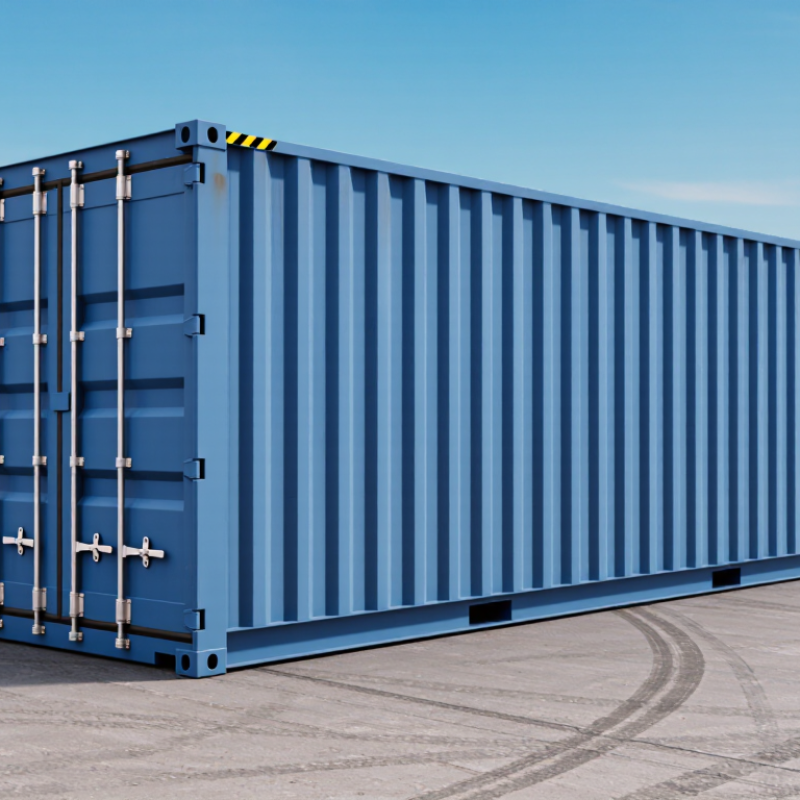
A 40ft container is a standardized steel unit designed for moving large cargo by sea, rail, and road. Its external length is about 40 feet, while common external dimensions are approximately 12.19 meters long, 2.44 meters wide, and 2.59 meters high. Internal dimensions vary slightly by manufacturer and container type. The standard version usually provides around 67 cubic meters of usable space. Exact figures should be checked before loading.
Its ISO-based structure supports predictable handling across international transport systems. A strong corrugated steel body protects cargo from rain, wind, and everyday handling impacts. Corner castings connect the container with lifting equipment and transport frames. Locking bars secure the double doors at the rear. The floor often uses thick timber panels over steel cross members. This design carries dense loads, but weight distribution still matters. A full container can become unsafe when heavy items are placed carelessly. That point is easy to underestimate.
Tips: Measure both cargo and door clearance before booking. Leave space for securing materials and airflow. Check the container’s identification plate, floor condition, door seals, and last inspection date. A high-cube model offers extra height, often about 2.90 meters externally, but it may not suit every route or terminal. In practice, small planning errors can cause expensive delays. Recheck the numbers.
What Is a 40ft Container?
A standard 40ft container measures 12.192 meters long, 2.438 meters wide, and 2.591 meters high externally. These dimensions define its footprint during transport, storage, and site planning. The length offers useful capacity for palletized cargo, machinery, furniture, and long packaged goods. However, the internal space is smaller because of wall panels, flooring, and door construction. That difference is easy to overlook.
In practical loading work, measure every item before booking space. A box may fit on paper but fail at the door. Internal width is usually close to 2.35 meters, while the doorway is narrower than the container body. Height also changes with flooring and roof structure. A few centimeters can decide whether equipment enters safely. Do not rely only on a supplier’s general specification. Confirm the exact unit, especially when cargo is tall, fragile, or difficult to reposition.
Tips: Leave clearance around the cargo for handling and ventilation. Check the route before delivery, including gates, turning areas, overhead cables, and ground strength. The container may fit the cargo but not the location. Recheck all measurements; planning errors happen surprisingly often.
A standard 40ft container has external dimensions of 12.192 m long, 2.438 m wide, and 2.591 m high.
The chart compares the standard external length, width, and height of a 40ft dry freight container. Dimensions are based on commonly used ISO container specifications; exact internal dimensions may vary slightly by manufacturer and container design.
A 40ft container offers about 67.7 cubic metres of internal capacity. That is roughly the space of a small apartment. Typical internal dimensions measure about 12.03 metres long, 2.35 metres wide, and 2.39 metres high. However, dimensions can vary by container type and manufacturer. Usable space is slightly less than the advertised volume. Door frames, corner posts, and uneven packaging can reduce loading efficiency.
The maximum payload usually ranges from 26 to 28 metric tonnes. Payload means the cargo weight, excluding the empty container. Always check the container’s tare weight and the transport route’s limits. A dense shipment may reach the weight limit before using the available volume. Lightweight cartons may fill the container first. Weight distribution also matters. Place heavy items low and near the centre. Do not rely only on estimates. In real loading work, small calculation errors can create major problems. A perfect plan rarely survives the loading floor.
A 40ft container is a standardized steel unit for international cargo transport. Its High Cube version adds vertical clearance rather than extra floor length. Under ISO 668:2020, a 40ft High Cube has an external height of 2.896 meters. A standard 40ft container is about 2.591 meters high.
Inside, the usable height is usually close to 2.70 meters. Internal dimensions vary slightly with flooring, wall panels, and door construction. Typical internal capacity reaches approximately 76 cubic meters. That space suits lightweight, bulky cargo such as furniture, packaged machinery, and retail fixtures. Heavy cargo may reach the payload limit before using the available volume.
The extra height sounds modest. In practice, it can accommodate taller pallets or an additional packaging layer. A 40ft High Cube often provides around 12 percent more volume than a 20ft container, while keeping a similar width. UNCTAD’s Review of Maritime Transport 2024 reported approximately 858 million TEUs in global container port throughput during 2023. That scale shows why small efficiency gains matter across supply chains.
However, the 2.896-meter figure describes external height, not guaranteed loading clearance. Door openings, cargo stability, and transport-route restrictions still require checking. I would verify the container’s actual internal measurements before final packing. Specifications are useful, but real units are not perfectly identical.
What Is a 40ft Container?
A 40ft container is a standardized steel freight unit measuring 12.192 meters long, 2.438 meters wide, and 2.591 meters high. ISO 668 defines these external dimensions, corner fittings, and basic size classifications. Its capacity equals two twenty-foot equivalent units, or TEUs. A high-cube version adds approximately 305 millimeters of height. That extra space matters for bulky cargo.
ISO 668 compatibility allows the same container to move between ships, railways, trucks, and terminals. Twist-lock fittings secure it to ship decks, rail wagons, and chassis. Cranes and reach stackers use the same corner points during lifting. This common geometry reduces reloading time and handling risks. UNCTAD’s Review of Maritime Transport 2024 reported about 858 million TEUs in global container port throughput during 2023. Standardization supports that enormous flow.
Compatibility is not automatic. Road axle limits, rail loading gauges, tunnel clearances, and terminal equipment can still restrict movement. A fully loaded 40ft unit may exceed local weight limits, even when its dimensions fit perfectly. The container also needs a valid safety inspection and suitable securing equipment. The assumption is tempting, but incomplete. Field experience shows small clearance errors can delay a transfer. Weather, uneven ground, and worn fittings deserve attention too. ISO 668 creates the physical language; local infrastructure determines how fluently that language works.
| Data Dimension | Typical or ISO-Related Value | Unit / Conversion | Compatibility Across Transport Modes |
|---|---|---|---|
| Container classification | ISO Series 1 freight container; nominal 40-foot length | 40 ft / 12.192 m nominal | The standardized corner fittings and external envelope support intermodal transfers between ships, rail wagons, road chassis, and terminal equipment. |
| External length | 12,192 mm | 40 ft 0 in | Ships and rail systems use ISO container positions based on nominal lengths. Road chassis are built to carry the same 40-foot footprint, subject to local vehicle regulations. |
| External width | 2,438 mm | 8 ft 0 in | This width fits standard ISO ship cell guides, many rail loading systems, and purpose-built road chassis. Road travel still depends on the permitted overall width in the jurisdiction. |
| External height: standard-height container | 2,591 mm | 8 ft 6 in | Generally suitable for standard vessel cells, rail routes, road chassis, and terminal stacking equipment, provided route and equipment clearances are adequate. |
| External height: high-cube container | 2,896 mm | 9 ft 6 in | Commonly accepted by ships and terminals designed for ISO high-cube units, but rail tunnels, bridges, crane clearances, and road height limits must be checked separately. |
| Typical internal length | Approximately 12,030 mm | Approximately 39 ft 5.5 in | The usable interior is shorter than the nominal external length because of the end walls, doors, fittings, and construction tolerances. |
| Typical internal width | Approximately 2,350 mm | Approximately 7 ft 8.5 in | The internal width accommodates common pallet and cargo layouts, but exact clear width varies with wall construction and lining. |
| Typical internal height | Standard: about 2,390 mm; high-cube: about 2,695 mm | Standard: about 7 ft 10 in; high-cube: about 8 ft 10 in | Cargo height must be checked against the actual container type, especially when moving between standard-height and high-cube equipment. |
| Typical door opening | Width: about 2,340 mm; height: standard about 2,280 mm, high-cube about 2,580 mm | Width: about 7 ft 8 in | Door clearances affect loading at warehouses, terminals, and rail or road transfer points. Actual dimensions vary by container design. |
| Internal floor area | Approximately 28.3 m² | Approximately 304 sq ft | Useful for planning pallet placement, although payload distribution and axle limits are more restrictive than floor area alone. |
| Approximate internal volume | Standard: about 67.7 m³; high-cube: about 76.3 m³ | Standard: about 2,390 ft³; high-cube: about 2,695 ft³ | Volume is useful for cargo planning, but the permitted gross mass and route-specific weight limits remain controlling constraints. |
| Maximum gross mass | Up to 30,480 kg for the common ISO rating | 67,200 lb | The allowable gross mass is marked on the container safety plate. Ship, rail, road, and terminal operations may impose lower limits. |
| Typical tare mass | Approximately 3,700–4,200 kg for a dry container | Approximately 8,160–9,260 lb | The exact tare is equipment-specific and must be taken from the container markings or transport documentation. |
| Theoretical payload at ISO gross rating | Approximately 26,280–26,780 kg before other restrictions | Approximately 57,940–59,040 lb | Calculated as maximum gross mass minus tare. Actual shippable payload can be lower because of road axle limits, rail limits, cargo securing, and route regulations. |
| Corner fitting spacing | Standardized ISO corner castings at the eight corners | Lengthwise spacing corresponds to ISO 40-foot geometry | Twistlocks, ship cell guides, rail wagon fittings, road chassis locks, and terminal spreaders engage these fittings for lifting and securing. |
| Ship compatibility | Designed for ISO container-cell and lashing systems | 40-foot position = 2 TEU nominally | A 40-foot unit occupies two twenty-foot-equivalent positions. Vessel-specific stack weight, lashing, and high-cube clearance requirements still apply. |
| Railway compatibility | Compatible with intermodal rail wagons equipped for ISO containers | Route-dependent loading gauge and axle limits | The container dimensions are standardized, but bridge strength, tunnel clearance, wagon capacity, and regional loading gauges determine whether a particular route is permitted. |
| Truck compatibility | Requires a 40-foot container chassis or compatible skeletal trailer | Overall vehicle length and mass are jurisdiction-specific | ISO dimensions allow mechanical connection, but legal gross mass, axle spacing, bridge limits, road height, and permitted trailer length must be verified locally. |
| Terminal handling | Lifted by equipment using ISO corner fittings | Top lift, side lift, or bottom lift depending on equipment | Cranes, reach stackers, straddle carriers, and transfer systems must match the container length, gross mass, lifting method, and corner-fitting condition. |
| TEU equivalent | 2 TEU | One 40-foot unit = two nominal 20-foot units | TEU is a capacity-counting measure, not a statement of usable volume, payload, or exact operating clearance. |
| Intermodal compliance checks | ISO dimensions, serviceable corner fittings, valid safety approval, declared gross mass, and suitable cargo securing | Check container markings and transport documents | ISO 668 compatibility establishes the basic dimensional interface; it does not remove local road, rail, vessel, terminal, customs, or safety requirements. |
Note: Dimensions and masses are representative values for common dry 40-foot containers. Actual specifications vary by container type, construction, age, and approval plate. Always verify the individual unit and the regulations for the planned route.
CUSTOMER ALERT Beware of fraudulent websites using our name. We do not sell on Craigslist or Facebook Marketplace. Report suspicious contacts to 713-670-8801.